

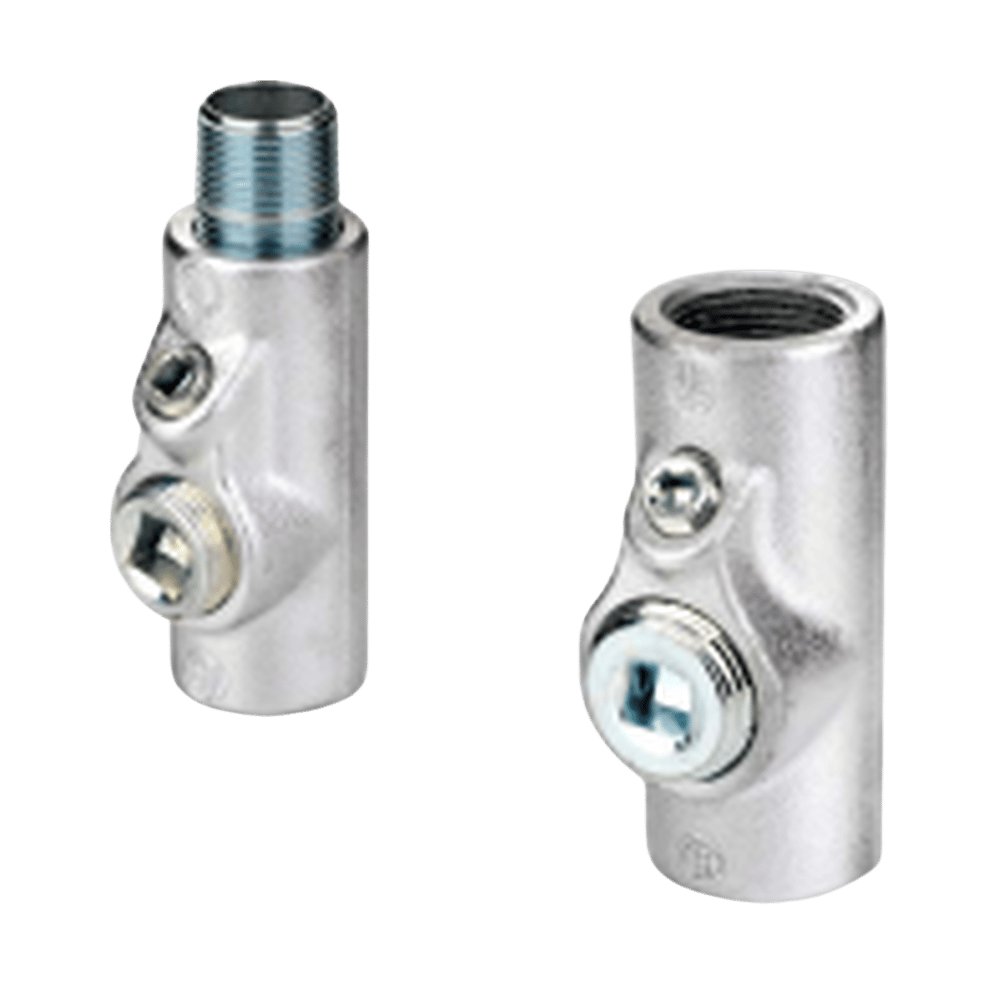
EYS and ENY models have manufacturer-defined mounting orientations and conduit-size ranges. CEC Section 18 determines when and where a seal is required; the certified fitting instructions determine which orientations and compounds the product permits.
Explosion-Proof Sealing Fittings (EYS & ENY)
EYS and ENY fittings form field-installed seals in hazardous-location conduit systems. Under CEC Rules 18-104 and 18-154, the required seal and placement depend on the Zone, enclosure type, ignition-capable components, factory-seal marking, entry method and boundary condition. An explosion seal can contain flame propagation and may also serve as a flammable-fluid migration seal when its construction and installation meet that purpose. Use only the compound named in the fitting instructions, keep the seal accessible and match every fitting to the conduit trade size, orientation and hazardous-location marking. Send the enclosure schedule and classification drawing for a fitting takeoff.
- Canada-wide project support
- UL & cUL certified models
- Configuration support
- Technical submittal support
Product catalog
Filter by classification and fixture type to narrow the range. Every model links to its full specifications, certification records and photometric files.
1 models shown
Typical Applications
- Class I Division 1 → Division 2 boundaries
- Equipment enclosure entries
- Conduit run breaks
Specifications at a glance
- Vertical (EYS) and horizontal (ENY) variants
- Trade sizes 1/2" through 4"
- Compound and fiber dam supplied separately
Related Industries
Related selection guides
Frequently Asked Questions
Common questions about explosion-proof sealing fittings (eys & eny) and hazardous location requirements.
Get your fixture schedule reviewed
Send the classification drawing, fixture schedule or lighting requirements. We will compare suitable models, applicable records and lead times before quoting.